

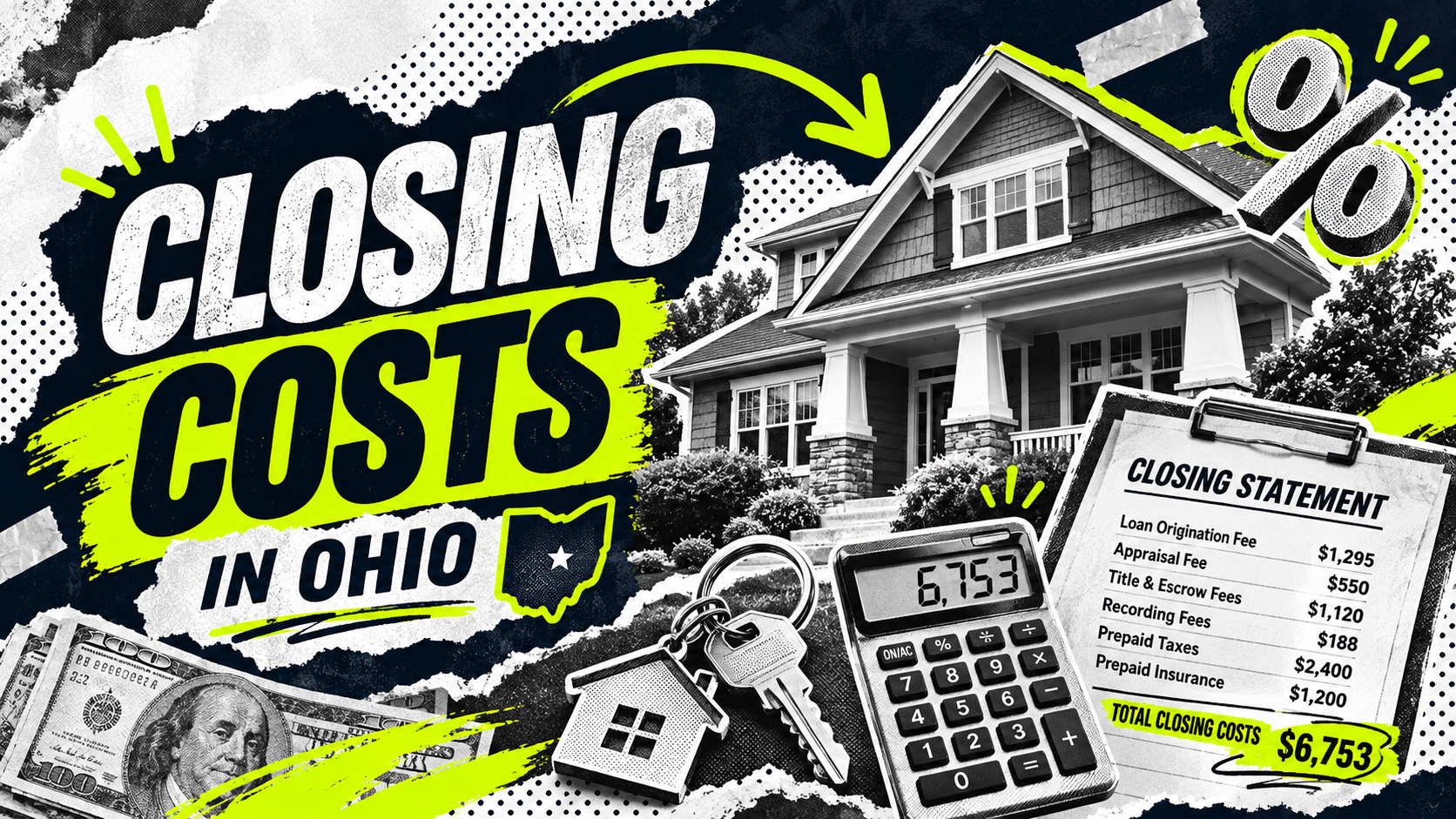
Buying a house for $350,000 does not mean you only need your down payment.
There are also costs associated with getting the mortgage, transferring the property, setting up insurance and taxes, and preparing everything for closing.
Those are generally referred to as closing costs.
And they’re one of the most common surprises we see with first-time home buyers.
A common planning range for closing costs is roughly 2% to 5%, but your actual number depends on the loan, property, taxes, insurance, title costs, credits, and closing date.
The important part:
Closing costs are not the same thing as your down payment—and neither one is necessarily the same as your final cash to close.
1. What are closing costs?
Closing costs are the expenses associated with getting your mortgage and completing the real estate transaction.
The CFPB describes them as the upfront costs required to obtain the loan and transfer ownership of the property.
Depending on the transaction, they may include things like:
lender fees
appraisal
credit and verification services
title work
title insurance
settlement or closing fees
county recording fees
mortgage-related government fees
prepaid interest
homeowners insurance
initial property-tax and insurance escrows
discount points, if you choose to pay them
Not every buyer will have every fee.
And not every fee is controlled by your lender.
That’s why a generic online closing-cost calculator can only get you so far.
2. Closing costs and cash to close are different
This distinction matters.
Closing costs are the expenses associated with the loan and transaction.
Cash to close is the actual amount you need to bring to closing after everything is added and subtracted.
Your cash to close can include:
your down payment
closing costs
prepaids and escrow funding
And then it can be reduced by things like:
earnest money you already paid
seller credits
lender credits
eligible assistance funds
other transaction adjustments
The CFPB’s Loan Estimate specifically separates closing costs from your Estimated Cash to Close, which incorporates the down payment, deposits, credits, and adjustments.
Ask, “What is my total out-of-pocket amount, and what exactly makes up that number?” That gives you a much better picture of how much money you actually need.
3. What usually makes up closing costs?
Let’s break the major categories down.
Lender costs
These are costs associated with originating and processing your mortgage.
Depending on the lender and loan, you may see charges such as:
origination
processing
underwriting
application or verification charges
discount points
The CFPB groups these as origination charges on the Loan Estimate.
When comparing lenders, don’t look at one isolated fee.
Look at the total lender costs, interest rate, lender credits, and overall loan structure together.
Appraisal
Most mortgage transactions require an appraisal.
The appraiser provides an independent opinion of the property’s value for the lender.
The exact cost depends on the property, location, complexity, and type of appraisal required.
Title and settlement costs
Title-related charges may include:
title search or examination
title insurance
settlement or closing services
document preparation
other title-company services
These are third-party costs and can vary between providers and transactions.
Recording and government fees
Documents such as your mortgage and deed have to be recorded.
Ohio establishes statutory county-recorder charges. Under current Ohio law, recording and indexing generally includes $34 for the first two pages and $8 for each additional page, with a possible document-preservation surcharge of up to $5. Your final recording cost depends on the documents and number of pages actually recorded.
These are generally not meaningful costs to “shop” between mortgage lenders because they’re tied to the transaction and public recording requirements.
4. Prepaids and escrows can make the number look bigger
This is where buyers sometimes look at the closing-cost section and think:
“Why am I paying all this extra money?”
Some of the money due at closing isn’t really a fee.
It may be money being set aside for expenses you would have had anyway.
Examples include:
Homeowners insurance
It’s common for the first year of homeowners insurance to be paid at or before closing.
Prepaid interest
Mortgage interest generally begins accruing when you close.
Depending on the day of the month you close, you may prepay interest from closing through the end of that month.
Property-tax escrow
If your mortgage uses an escrow account, part of your upfront cash may establish the initial balance used to pay future property-tax bills.
Insurance escrow
The lender may also collect money to establish the homeowners-insurance portion of your escrow account.
The CFPB separates Prepaids and the Initial Escrow Payment at Closing on the Closing Disclosure for exactly this reason.
Some of that money may simply be setting aside funds today for taxes, insurance, or interest that will become due later.
5. Why Ohio property taxes matter
Property taxes can have a meaningful impact on your cash-to-close calculation.
Ohio property-tax timing can also be confusing because taxes are generally billed in arrears, and exact billing schedules and settlement practices can vary by county.
That means a closing in Franklin County may not look exactly like a closing in Delaware, Licking, Pickaway, or another Ohio county.
Your settlement statement may contain tax prorations or credits between the buyer and seller based on:
the closing date
the county
which tax bills have already been paid
which tax periods are still owed
the purchase contract
title-company calculations
That’s one reason we prefer estimating closing costs using the actual property address whenever possible instead of using only a percentage.
6. Seller credits can reduce what you bring to closing
A seller may agree to contribute money toward allowable buyer closing costs.
For example:
Suppose your estimated eligible closing costs and prepaids total $11,000.
If your purchase agreement includes a $7,500 seller credit, that could substantially reduce your out-of-pocket amount.
Seller contributions are subject to loan-program requirements and transaction limits, so they need to be structured correctly.
But in the right transaction, seller credits can be extremely useful.
They may allow a buyer to preserve more cash rather than using every available dollar at closing.
7. Lender credits can also reduce closing costs
Another option may be a lender credit.
A lender credit reduces some of your upfront closing costs.
But it usually isn’t free money.
The CFPB explains that lender credits are typically provided in exchange for accepting a higher interest rate than you otherwise would have received.
That creates a tradeoff:
Less money due today → potentially higher monthly payment
versus:
More money due today → potentially lower interest rate
Neither choice is automatically right.
It depends on your goals, available cash, and how long you expect to keep the mortgage.
We want to see the break-even point. If paying another $4,000 upfront saves only $35 per month, that is a very different decision than paying $4,000 to save $150 per month.
8. What do closing costs look like on a $350,000 home?
Let’s use a simple example.
Assume:
Purchase price: $350,000
Down payment: 5%
Down payment: $17,500
Approximate loan amount: $332,500
Using a broad 2%–5% planning range on the loan amount would suggest roughly:
2%: about $6,650
3%: about $9,975
4%: about $13,300
5%: about $16,625
That is not a quote.
It’s simply a planning range.
Your actual amount could be different because of:
loan program
interest-rate points or credits
title costs
appraisal
homeowners insurance
property taxes
closing date
seller contributions
escrow requirements
property location
This is why we prefer running an address-specific estimate before you make an offer.
9. Your earnest money is not an extra closing cost
This trips buyers up all the time.
Let’s say you put down:
$3,000 in earnest money
That money generally does not disappear.
Assuming the transaction closes normally and the contract allows it, your earnest money is typically credited toward the amount you owe at closing.
So if your final cash requirement were $25,000 and you had already deposited $3,000 in earnest money, that deposit would generally be reflected when calculating the remaining amount due.
The CFPB’s Estimated Cash to Close calculation specifically accounts for deposits already paid to the seller.
10. When do you find out the real number?
Early in the process, you should receive a Loan Estimate.
For most mortgages covered by these disclosure rules, the lender must provide the Loan Estimate within three business days after receiving the mortgage application. It includes the estimated interest rate, monthly payment, and closing costs.
Later, you receive the Closing Disclosure.
The lender generally must provide that document at least three business days before closing. It shows the final loan terms, costs, credits, and cash to close.
Those two documents should tell the same basic financial story.
If something changes significantly, ask why.
Before wiring money for a home purchase, verify the instructions directly with the title or settlement company using a phone number you independently know is correct. One phone call can prevent a catastrophic mistake.
11. Can you shop closing costs?
Some costs are more negotiable or shop-able than others.
The CFPB specifically distinguishes between:
services you cannot shop for
services you can shop for
on the Loan Estimate.
You can also compare lender origination charges and lender credits between Loan Estimates.
But don’t assume the loan with the smallest-looking fee section is automatically cheaper.
A lender can sometimes offset closing costs with a higher interest rate.
You need to compare the entire package.
Closing cost FAQs
Are closing costs included in my down payment?
No.
Your down payment and closing costs are separate components of the transaction.
Are closing costs the same as cash to close?
No.
Cash to close includes the full transaction calculation after considering your down payment, closing costs, deposits, credits, and other adjustments.
How much should I budget?
A common starting point is roughly 2% to 5%, but actual costs depend on the property and transaction.
Can the seller pay my closing costs?
Potentially.
Seller contributions may be permitted subject to your purchase agreement and applicable loan-program rules.
Can I finance my closing costs?
Sometimes certain costs can be offset through lender credits or otherwise incorporated into the financing structure, depending on the loan and transaction. But reducing upfront costs may increase your interest rate, loan amount, or long-term cost.
When will I know exactly how much money to bring?
Your final Closing Disclosure shows your Cash to Close. For most covered mortgage transactions, you should receive it at least three business days before closing.
Your real number depends on the home, loan, property taxes, insurance, title costs, credits, deposits, and closing date. That’s why we prefer to run the numbers on the actual property before you make the decision.
Run my numbers →This information is for educational purposes only and is not a commitment to lend. Closing costs, loan programs, rates, qualification requirements, taxes, insurance, settlement charges, and program guidelines vary and are subject to change. Additional restrictions may apply.